

Investing in social change with a business mindset.
I devote more than a 10th of my energy to philanthropy. When Blackstone went public in 2007, the sale of shares gave me resources far beyond anything I needed for myself.
The following year, I committed $100 million to a major transformation of the New York Public Library. From that point on, my giving began in earnest. To date, my philanthropic commitments have totaled roughly $1.5 billion.
As I mentioned in the second installment of this series, the impulse reaches back to my childhood. I grew up watching my grandparents send a steady stream of supplies to fellow Jews living in Israel.
Philanthropy is also woven deeply into the American tradition. It is regarded as an "absolute good." Live in New York, and you quickly see that the city's museums, theaters, universities, hospitals and cultural institutions have long depended on the generosity of wealthy benefactors.
My own approach, however, differs from that of the conventional philanthropist.
First, I seek to bring about change on a large scale.
I committed $350 million to support research and education in artificial intelligence at the Massachusetts Institute of Technology.
Strengthening MIT itself was only part of the purpose. Faced with the prospect of being overtaken, Stanford, Carnegie Mellon and other leading institutions would be compelled to reinforce their own AI programs. Competition would intensify, innovation would accelerate, and the capabilities of the country as a whole would rise.
The larger objective was to make the entire American system more competitive and more deeply focused on artificial intelligence.
Second, I try to do what no one else can. If someone else is prepared to provide the money, I am generally happy to leave the task to them. I look instead for important causes that no one else is willing or able to support.
Third, I retain a meaningful role in the outcome. The typical philanthropist gives money to an institution and hopes for the best. If the project begins to go wrong, there may be little the donor can do.
I approach matters differently. I seek a position of equal standing—or greater—in the decision-making process, and I remain actively involved to ensure that the objective is achieved.
The success of Schwarzman Scholars gives me particular satisfaction.
I founded the program at Tsinghua University in China in 2013, and its first class enrolled in 2016.
Ever since the Chinese government invested in Blackstone in 2007, I had been closely engaged with China. Out of that experience grew a concern.
If China continued expanding at double-digit rates year after year while the advanced economies struggled to achieve anything comparable, people in those countries might increasingly direct their frustration and resentment toward China.
The resulting tensions might not remain confined to trade.
So I began with a simple idea: bring talented young people from around the world to China while there was still time. Let them learn about the country firsthand—not only through daily life, but through meetings with its leaders and travel throughout the nation. Then let them return home equipped to deepen understanding and help manage their countries' relations with China.
The program has now reached its 10th anniversary, and its results have exceeded my hopes.
Some 1,500 graduates have returned to more than 100 countries. They are emerging as political leaders, entrepreneurs, advisers to prominent executives and government officials, and heads of nongovernmental organizations. My next goal is to increase that number to 15,000.
Masa—Masayoshi Son, the founder and chief executive of SoftBank Group—contributed more than $25 million to the initiative, while former Prime Minister Shinzo Abe sent Japanese government officials to take part as students.
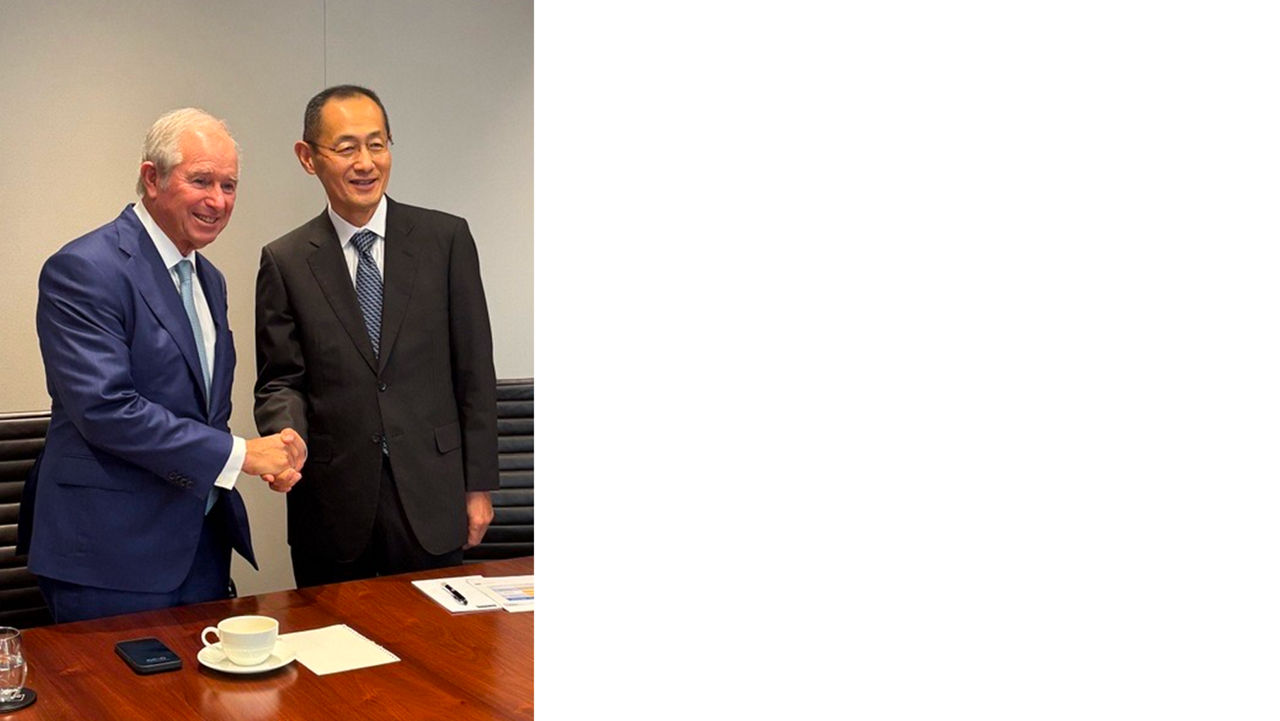
Last year, I also made my first philanthropic gift in Japan. It provides financial support for professor Shinya Yamanaka of Kyoto University and his work applying induced pluripotent stem cells-iPS cells-to the treatment of cancer.
Through my philanthropy, I had already developed a deeper understanding of cancer research. Jennifer Doudna, a professor at the University of California, Berkeley, an old acquaintance and, like Dr. Yamanaka, a Nobel laureate, encouraged me to support the work.
Learning that professor Yamanaka also had the backing of the Japanese government reinforced my conviction.
Age has taught me something. My success was never mine alone. It was possible only because I lived in a society that gave me opportunities, education foremost among them. How could I not be grateful?
Capitalism has a side effect: It produces inequality of income and opportunity. Philanthropy can return part of the wealth one has earned to society and help soften those disparities.
If I can widen the range of opportunities available to others, then doing so is not merely an act of generosity; it is a responsibility.