

Find what you love—and become great at it.
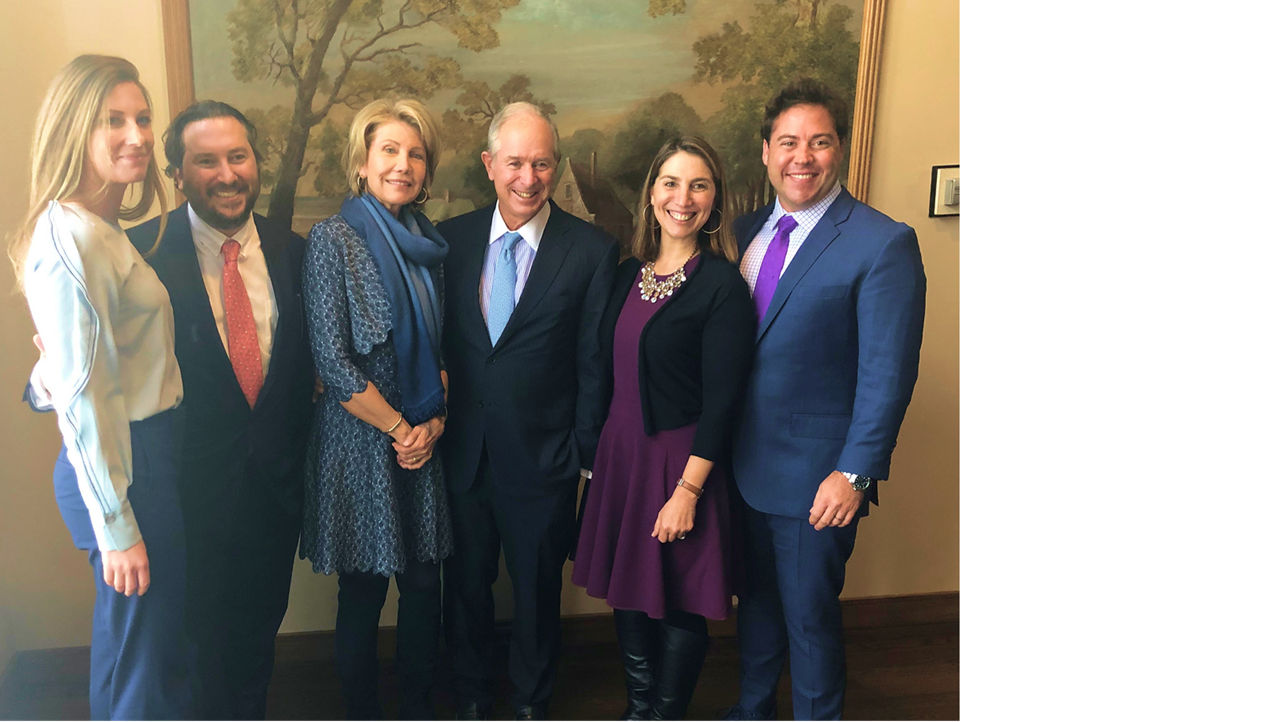
However important the business before me, there are three people whose calls I will always take: the President of the United States, my wife, Christine, and my daughter Zibby.
In June 2007, Blackstone went public. The first stop on our roadshow—the presentations to prospective investors—was at the Pierre, the storied Fifth Avenue hotel overlooking Central Park. More than 800 people arrived, far exceeding the capacity of the ballroom, and we had to open a second room.
In the middle of my presentation, my phone rang. It was Zibby. I stepped outside to answer. The twins were on their way.
When I returned to the podium, I told the audience that my first grandchildren were about to be born and finished my speech. I then left the rest to our president, Tony James, I rushed to my daughter's side.
I have two children from my first marriage.
Zibby became a writer. She interviews authors about their latest books, hosts a popular literary podcast, and runs a thriving book club.
My son Tedd—you may remember him as the little boy who, some 40 years earlier in Tokyo, was generously plied with sake by Yasuo Kanzaki of Nikko Securities before promptly falling asleep—is today a successful film producer.
When they were growing up, there was one decision I made after a great deal of thought: I would never place the burden of my own expectations on their shoulders.
From an early age, I had lived under constant pressure to succeed. The stress was relentless, and as my career advanced, it only intensified. I had no desire to pass that burden on to my children.
Instead, I told them, over and over, that I did not care what profession they chose.
"What matters," I would say, "is that you find something you truly love, devote yourself to it completely, and become exceptionally good at it." More than anything, I wanted them to experience the satisfaction that comes from doing something well.
Beyond that, there is little a parent has the right to ask. I also resolved never to measure them against anyone else's accomplishments.
Looking back, I believe that was the right choice. Both of my children have built happy families of their own. I now have seven grandchildren, one of whom now attends Yale, my alma mater.
If they grow into independent, thoughtful and compassionate people, then they have succeeded on their own terms. Whatever they choose to do with their lives, my role now is simply to stand a little farther back, offering a very high level of emotional support.
Christine and I married in 1995. It was the second marriage for both of us. We met through a mutual friend, and from the beginning we simply fit together.
She possesses boundless energy and remarkable creativity. She is joyful, fun-loving, and a delight to be with. Everyone should be fortunate enough to marry someone like that.
Christine practiced law as an intellectual-property attorney before embarking on an entirely different career. In recent years she has become one of the leading theater producers in New York and London, winning multiple Tony Awards, the highest honor in American theater.
She is a devout Catholic who attends church every Sunday. I am Jewish, and it never occurred to me to ask her to convert. I married her because I loved her, not because I wanted to change her. Although I cannot accompany her to church, if her faith brings her peace and happiness, then the sensible thing is to encourage her to embrace it fully.
Laughter has always been part of the culture of the Schwarzman household. Even now, when I get together with my brothers, Mark and Warren, who are twins, the conversation soon turns playful. One of our standing subjects is genetics.
The three of us grew up in the same house, with the same parents and essentially the same education. We attended the same elementary school, junior high school and high school. Yet our lives turned out very differently.
Our family explanation is that I won what my brothers call the "gene derby." According to their theory, I happened to inherit the most advantageous combination: my mother's drive and my father's intelligence. They received something closer to the reverse—more of my father's sweetness and easygoing nature, together with more of my mother's intellectual gifts. They insist that, when the genes were handed out, I got the best mixture available and they were a little shortchanged.
Humor makes a house a comfortable place to live and builds relationships in which people support one another. My hope is that every family can create a home like that.
Originally published in the Nikkei, October 2026