

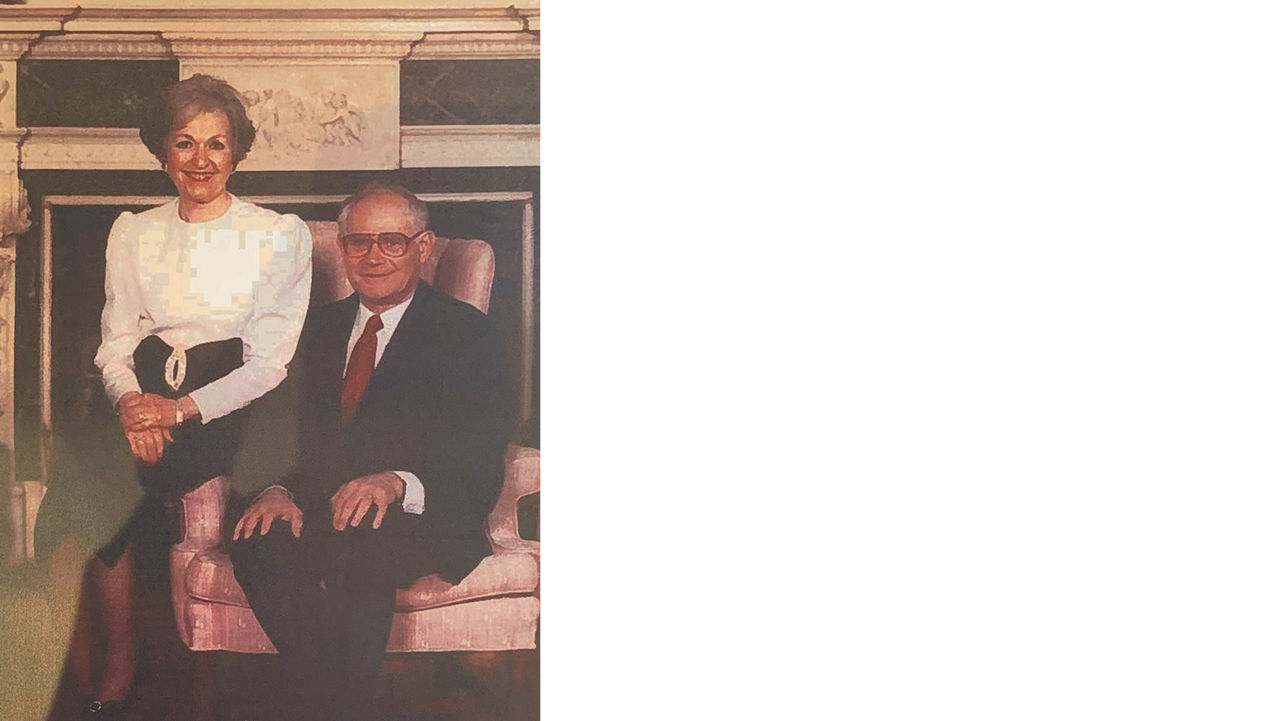
My mother defied my father to move us from a rough neighborhood.
The Schwarzman family traces its roots to Jewish immigrants from Austria. My great-grandfather William came to Philadelphia in 1883 and opened a dry-goods store that carried a wide range of merchandise.
After William died, his three children divided the estate and each opened a store of their own. One of them was my grandfather, Jacob. His shop stood in Oxford Circle, then a Jewish neighborhood in Philadelphia.
I was born in 1947 and helped out at the store from the time I was a boy. My grandfather impressed upon me a lesson: "The most important thing to do in life is protect your good name."
Together with my grandmother, Rebecca, he supported fellow Jews in Israel who had been orphaned by war. He filled one of his warehouses with toys and wheelchairs and, every few months, shipped them to the orphans of Israel, then a newly founded and impoverished nation in the years after World War II.
After the war, the United States was one of the few countries with real financial strength. For my grandfather, helping others was less an act of charity than a duty, and he regarded it as an essential part of life. He kept up his giving for the rest of his life, and watching him do so planted the same conviction in me.
He was a perfectionist, fixed on keeping everything under his command and control. He would station himself at the cash register like the captain of a ship, with a view of the entire store, keeping a sharp eye on whether those of us minding the counter wrapped every purchase beautifully before handing it to the customer.
As I will describe later, Blackstone, too, is built on a kind of perfectionism not unlike the discipline with which my grandfather made sure everyone in his store behaved impeccably.
It was my father, Joseph, who took over the store. Like the Japanese of an earlier era, when hard work was woven into the national ethos, he worked seven days a week.
He was smart, but content and modest. No matter how much I urged him, he refused to expand the business into a chain of stores. "I'm happy," he would say. "I don't need more."
His face was the spitting image of the famed investor Warren Buffett's. I once asked Warren about his ancestry, and I believe we may be distantly related.
It was at a summer camp in Pennsylvania that my father fell in love with my mother, Arline, who came from the Bronx in New York.
Perhaps because she had lost her own father early, she was strong-willed and fiercely competitive. She drove us children to keep moving forward, always, as if we were running on a treadmill. She was not a mother who handed out praise.
The gentle and the tough. My twin brother and I inherited the DNA of two parents who could not have been more different.
The first turning point in my life came with a move during my junior high school years. Oxford Circle in those days was a rough place. The father of my no-good friend Chuck Weiner was killed by the Mafia.
After his father was killed, Chuck invited me over to his house. There, he secretly showed me a toolbox stuffed with bundles of a hundred-dollar bills—at a time when a part-time job paid 10 cents an hour.
One day, while shopping for clothes with my mother, I begged her to buy me a black biker jacket bristling with chrome studs. That was what the "cool kids" at school wore, I told her. Aghast, my mother insisted that we move, overruling my reluctant father, who worried that a move would take us "far from the store." But my mother resolved to get us out of the "wrong neighborhood" for children.
Our destination, though still in Pennsylvania, was Abington, a 99% Christian, upper-middle-class suburb. "This is a different America!" I thought, stunned.
To this day, I have never put much faith in opinion polls. I prefer to look first at the makeup of a population before drawing conclusions about what people think. I owe that instinct to my mother, who exposed me to two different worlds.
My mother lived to the age of 92, while my father died in 2002 at 82. Although he had retired by then, I wish he had lived another 10 years to see his son's success.
When I left for college, he made sure I knew I had a place to come back to. "I can't help you. You are going to be on your own," he told me. Then he added, "But you should always know that I love you, and you can always come home." He was a gentle man. His death was the saddest day of my life.
Let me return to my days minding my grandfather's store. There, I came across a Japanese transistor radio and marveled at how small it was, and how well it worked.
After the war, Japan had all but vanished from the minds of Americans. That little radio was how I first came to understand that Japan was rising again.
Originally published in Nikkei Asia, October 2026