

Starting from scratch was hard with potential clients bound by old relationships.
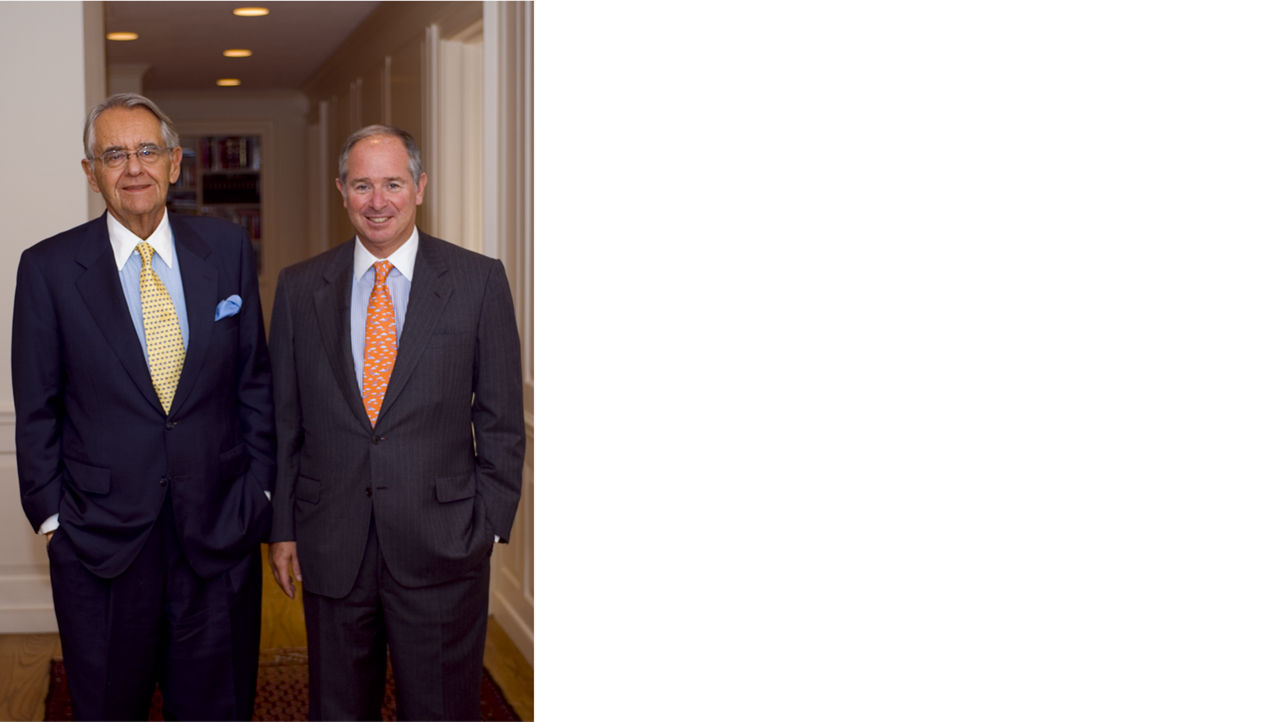
My first encounter with Pete Peterson, with whom I would co-found Blackstone in 1985, dates back to 1973, when he was brought in as CEO of Lehman Brothers.
I was in my second year at the firm. Pete had been chosen for a peculiar reason: Because he knew little about finance, he posed no threat to any of the firm's warring factions. Each side assumed he would be easy to manage.
Soon after arriving, Pete sent a memo to the entire staff asking for ideas about how to improve the firm's performance.
"The firm is not doing well," he wrote, in effect. "What business strategy would you recommend that we adopt so that we can have greater success?"
I wrote up a business plan for the firm. As it turned out, I was the only person who responded to Pete's memo. Pete called me in, and after we discussed the strategy I had proposed, he said, "You and I should work together."
With the impudence of youth, I declined. "That's a terrible idea," I told him.
"I don't think you have any idea what you're doing in finance," I said, trying to explain my reasoning. "I understand from people who have worked with you that you ask an enormous number of questions because you're trying to learn. I know almost nothing, so I can't help you learn and you can't help me learn. So we shouldn't work together."
Then I added, "When I have learned enough to feel confident, I'll call you and tell you I'm ready."
Two years later, I telephoned him. "I'm ready to work with you," I said.
From then on, we worked as a team.
So it was when we founded our own firm in 1985. In the weeks before the launch, Pete and I met every morning in the courtyard restaurant of the Mayfair Hotel in New York to debate what our business model should be. The question we kept asking ourselves was simple: What could we do that no one else had done before? We needed a unique strategy. If all we did was what everyone else did, why would anyone use us?
We decided to begin with three pillars.
The first was to be a small investment bank, known as a boutique, advising corporations on mergers and acquisitions. Because the number of clients would be limited, there would be no conflicts of interest among them. Companies could entrust us with their business in confidence. No firm quite like that existed at the time.
The second was to be a buyout fund in a field then known as leveraged buyouts, or LBOs. I had advised on such deals in my Lehman days and knew my way around them. Today there are thousands of such firms around the world. Back then, there were perhaps 10.
The third was to begin new ventures. We would read the shifting currents of finance and wait for the right moment to move. We set two conditions for any new venture. First, we had to find a "10 out of 10" person to lead it. Second, it had to generate what we called intellectual capital, value invisible to the eye but capable of enriching our existing businesses.
The classic example was the liquid asset management business we launched in 1988 by bringing in Larry Fink. I will return to that story in more detail later. The business eventually left our fold and grew into BlackRock, the largest asset manager in the world.
Larry was a truly exceptional talent, an 11 out of 10. Investment in liquid assets sits close to the pulse of the macroeconomy. To manage bonds well, one has to read central banks, interest rates, inflation and credit conditions. That knowledge, I believed, could only strengthen the rest of our business.
No other firm in the world rested on these three pillars.
As for the name Blackstone, we drew on the origins of our two family names. "Schwarz," from my German-Jewish background, means "black." "Petro," from Pete's father's original Greek name, Petropoulos, means "stone" or "rock." We combined the two and became Blackstone. We each put in $200,000 and on Oct. 1 we opened our doors with $400,000 in capital.
Then we swung and missed, again and again.
We mailed over 400 letters announcing our launch. Not a single piece of business came in. Even the story The Wall Street Journal was planning to run on our founding was killed after interference from Lehman.
We had assumed that our reputations would speak for themselves and that companies would hire us. But we had overlooked something essential: Any client who chose us would have to justify that decision to the large financial houses on which it had long depended. They had to apologize for using us. We thought we knew what we were doing but we did not fully understand the client's problem. It is a trap entrepreneurs often fall into.
For the buyout fund, we had publicly declared that we would raise $1 billion, which would make it one of the largest pools of capital in the world. Yet in the United States, we managed to gather only $175 million.
What rescued us from that predicament was Japan.
Originally published in the Nikkei, October 2026