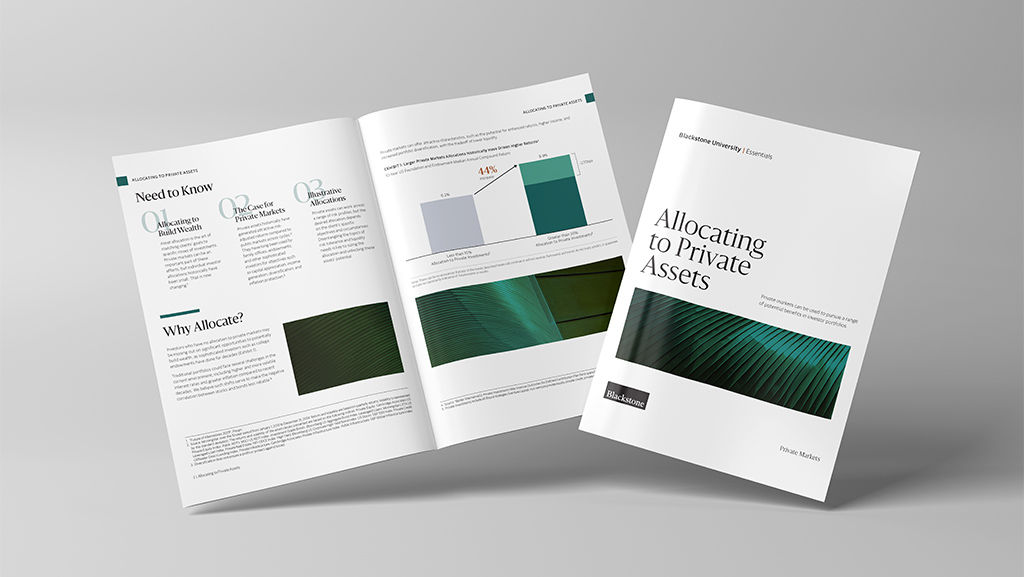

Essentials of Allocating to Private Assets
Private markets can be used to pursue a range of potential benefits in investor portfolios.
Download brochure
Introduction To Allocating to Private Assets

Allocating to Build Wealth
Asset allocation is the art of matching clients’ goals to specific mixes of investments. Private markets can be an important part of these efforts, but individual investor allocations historically have been small. That is now changing. [ 1 ]

The Case for Private Markets
Private assets historically have generated attractive risk-adjusted returns compared to public markets across cycles. [ 2 ] They have long been used by family offices, endowments, and other sophisticated investors for objectives such as capital appreciation, income generation, diversification, and inflation mitigation. [ 3 ]

Illustrative Allocations
Private assets can work across a range of risk profiles, but the desired allocation depends on the client’s specific objectives and circumstances. Disentangling the topics of risk tolerance and liquidity needs is key to sizing the allocation and unlocking these assets’ potential.
WHy allocate To PRIVATE ASSETS
Larger private markets allocations
historically have driven higher returns
Investors who have no allocation to private markets may be missing out on significant opportunities to potentially build wealth, as sophisticated investors such as college endowments have done for decades.
Traditional portfolios could face several challenges in the current environment, including higher and more volatile interest rates and greater inflation compared to recent decades. We believe such shifts serve to make the negative correlation between stocks and bonds less reliable. [ 3 ]
Private markets can offer attractive characteristics, such as the potential for enhanced returns, higher income, and increased portfolio diversification, [ 4 ] with the tradeoff of lower liquidity.
Note: There can be no assurances that any of the trends described herein will continue or will not reverse. Past events and trends do not imply, predict, or guarantee, and are not necessarily indicative of, future events or results. There is no guarantee that any investment will achieve its aims or objectives or avoid substantial losses.
Historical outperformance COMPARED TO PUBLIC ASSETS
Private growth portfolio delivered ~2x public market returns over last
20 years
One of the main attractions of private markets is their potential for outperformance compared to public assets.
Historically, private asset portfolios have outperformed their public counterparts. As illustrated in Exhibit 2, an illustrative private market growth portfolio — designed to pursue capital appreciation — has delivered returns that are roughly twice those of a traditional 60/40 portfolio over the past 20 years.
Exhibit 2: Illustrative Private Growth Portfolio Delivered 2.1x Traditional 60/40 Returns Over Last 20 Years
Hypothetical Growth of $100,000
Note: Past performance does not predict future returns. This does not represent an actual portfolio managed by Blackstone. The above returns are hypothetical in nature and are shown for illustrative, informational purposes only. These returns do not reflect the actual or expected returns of any Blackstone portfolio strategy and are not a guarantee of future results. Nothing herein is intended as a prediction of how any financial markets, fund, or underlying manager will perform in the future. Illustrative portfolio returns are calculated based on net total returns, assuming quarterly rebalancing over the 20-year period from September 30, 2004 to September 30, 2024. Growth: (75% Equities / 25% Fixed Income). Equities is represented by the S&P 500, MSCI Emerging Markets Index and MSCI World ex US Index. Fixed Income is represented by the Bloomberg US Treasury Index (Unhedged) and Bloomberg US Corporate Bond Index (Unhedged). For Private Credit, we have used the Cliffwater Index with Blackstone’s approximate adjustment for leverage and fees. Please refer to Endnotes for definitions of public and private growth portfolio allocations.
When starting out, we believe initial considerations can include but are not limited to the following:
Private markets can be strategic, long-term investments. They are less liquid than public markets, an important tradeoff.
Understanding clients’ needs — such as liquidity and tax considerations — helps determine the right allocation strategy.
Who you invest with matters. The difference in outcomes among private markets managers can be wide.
In addition, a robust understanding of the key attributes of private market asset classes, including how to allocate within a multi-asset class portfolio, is key.
Note: This information is provided for illustrative purposes only and should not be considered research or investment advice.
Core Attributes of Private Assets
By using private markets, we believe investors can pursue many of their longstanding objectives, such as capital appreciation, income generation, diversification and inflation mitigation (see Exhibit 3).
Private equity, for example, can potentially offer capital appreciation, enhancing portfolio growth. Private credit may deliver higher income. Private real estate and infrastructure can typically provide a mix of both income and capital appreciation potential, with a degree of inflation mitigation. Private assets have the potential to provide diversification benefits [ 7 ]
Exhibit 3: Core Attributes of Private Market Asset Classes
Note: Represents Blackstone’s view of the current market environment as of the date appearing in this material only. The above information is provided for illustrative purposes only and should not be considered as research or investment advice. Past performance does not predict future returns. There can be no assurance that any Blackstone fund or investment will be able to effectively enhance returns, increase income, provide diversification, hedge inflation, provide tax advantages, implement its investment strategy, achieve its investment objectives or avoid substantial losses. Diversification does not ensure a profit or protect against losses. Any investment involves a high degree of risk and should only be made if an investor can afford the loss of the entire investment. Blackstone does not provide tax advice. Investors should consult their own legal, accounting and tax advisers to make an independent determination of the suitability and consequences of an investment.
Private markets encompass several distinct asset classes, each with its own characteristics. As Exhibit 3 illustrates, they tend to serve different roles in a portfolio, and those differences are part of what can make them effective in combination.
Held on their own, each is a distinct return stream. Because they have historically behaved differently at different points in a cycle, holding them together may provide diversification benefits and reduce volatility at the total-portfolio level.
Combining asset classes is not a mechanical exercise, however. Sizing and rebalancing across asset classes requires expertise. We believe this is one reason manager selection, and the scale and track record behind the underlying strategies, can be especially important in multi-asset private portfolios.

Private assets can be deployed across a range of risk profiles, but allocation decisions depend on the clients’ objectives and circumstances. This includes (but is not limited to) both their risk tolerance and the proportion of their overall portfolio dedicated to private assets.
It’s crucial to distinguish between clients’ risk tolerance and their liquidity needs. These concepts are often conflated, which can lead to sub-optimal allocations. It’s important to note that higher allocations to private assets do not necessarily equate to higher risk in portfolios. [ 8 ] Broadly, there are two paths and both can be effective.
The first is to build the allocation piece by piece—selecting and sizing individual private equity, private credit, real estate, and infrastructure exposures, and rebalancing among them over time.
The second is to access these asset classes through a single, multi-asset solution, where one manager combines them in a single, professionally managed allocation.
A single solution may offer a few potential advantages:
Simplicity, with one subscription and
one manager relationship rather than
sourcing and monitoring several
Diversification across asset classes
from the outset
A single manager to evaluate, in a
market where outcomes can vary
widely by manager
While a single, multi-asset solution may provide access to private markets, it’s not the only way. The right approach depends on investors’ objectives, resources, and preferences.
With those points in mind, here is an example of how a private markets allocation can be designed.
Note: Alternative investments involve a high degree of risk and investors may not get back the amount originally invested. There is no guarantee that any fund or investment will achieve its aims or objectives or avoid substantial losses.
Illustrative Growth Portfolio
A growth portfolio can be designed with private assets to pursue greater capital appreciation over time. This portfolio would favor private equity, but also include allocations to private real estate, infrastructure, and credit, in addition to
public equity and fixed income.
This style of allocation outperformed a traditional 60/40 portfolio over the last 20 years.
Exhibit 5: Growth Portfolio: Combining Public and Private Assets
Growth Portfolio with 30% Private Assets
Performance, 2005-2025
Compared to a traditional 60/40 portfolio (60% Equity / 40% Fixed Income)
Note: Past performance does not predict future returns. Source: Morningstar, Cambridge Associates, NCREIF, Cliffwater, as of December 31, 2025. As
commonly used in the industry, the 60/40 portfolio is 60% allocated to the MSCI ACWI Index and 40% is allocated to the Bloomberg Global Aggregate
Bond Index. The returns and volatility of the asset classes presented are based on the following indices: Private Equity: Cambridge Associates US Private
Equity Index. Private Real Estate: NFI-ODCE Index. Private Credit: Cliffwater Direct Lending Index. Private Infrastructure: Cambridge Associates Private
Infrastructure Index. Please note that Cliffwater Direct Lending Index is reported unlevered, gross of fees, and NFI-ODCE Index is reported gross of fees.
The indices and benchmarks reflected herein are not representative of all investments in the applicable asset classes, the performance of such indices and
benchmarks in periods other than that the 20-year period shown herein may differ materially, and it should not be assumed that any trends shown will
continue. Annualized returns and volatility are calculated based on the quarterly returns over the 20-year period from December 31, 2005 to December 31, 2025.
Considerations Before Allocating
Private market investing means active ownership of less liquid assets, as value creation takes time. Liquidity needs at the total portfolio level are one important consideration before allocating to private equity. In addition, manager selection may be of particular importance given the wider dispersion of returns compared to public markets. Key manager attributes include scale, staying power and a long track record.

Blackstone Private Markets Allocator Tool
Allocating to private markets can enhance performance and improve diversification. Use this tool to see how private markets may improve portfolio performance and help manage investment risk.