

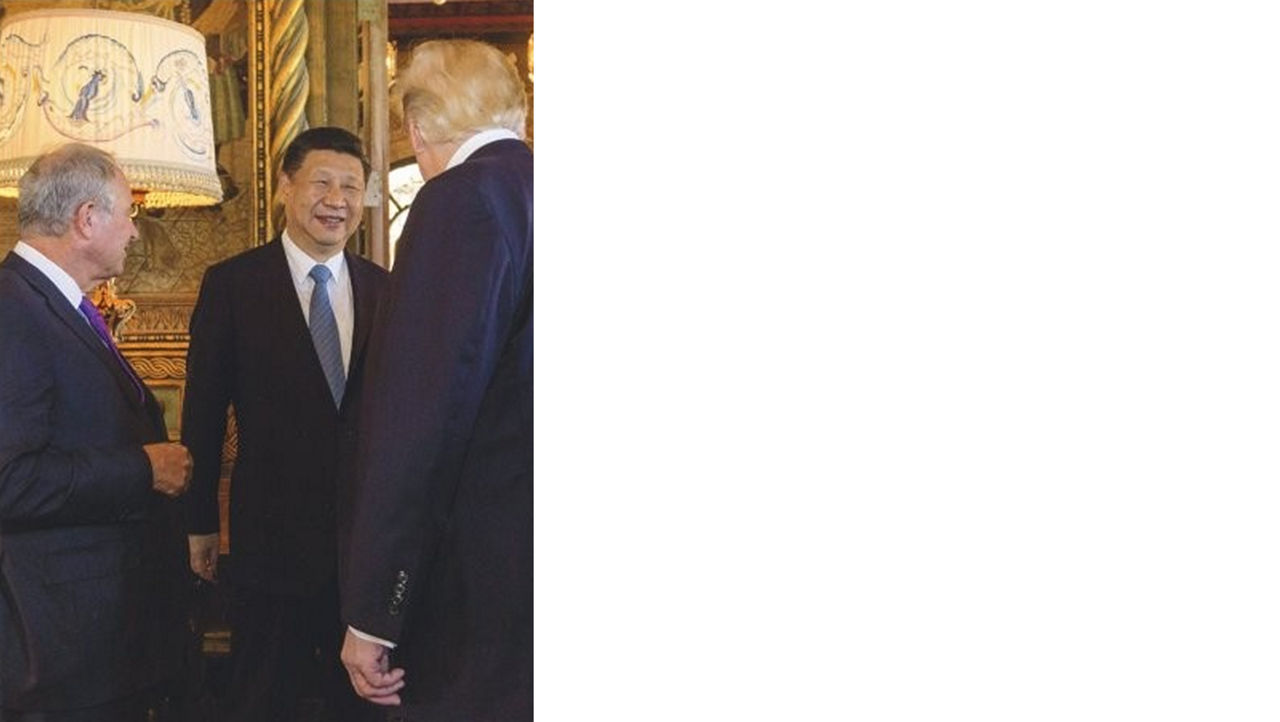
From postwar reconstruction to public service.
My acquaintance with President Donald Trump goes back to the 1980s, when he made a contribution to a charity dinner with which I was involved.
By the early 1990s, when Blackstone entered real estate investing, he was already a prominent figure in the business.
As his interests gradually turned toward politics, we began speaking from time to time. My house in Florida is a mile south of Mar-a-Lago, his private residence, and we were born only eight months apart. I am the younger of the two.
Around the time of the 2016 Republican National Convention, he invited me to breakfast with Melania.
"Can you believe I'm actually going to be nominated for president?" he asked. "No," I said.
"Neither can I," he replied.
At the beginning, I do not think he had been entirely serious about it himself.
After he won the presidential election that November, President Trump would sometimes look to me to be of service, and I helped whenever he asked. I assembled a group of leading business figures to advise the president. I also worked, carrying out the President’s agenda, with the leaders of Mexico and Canada as the three countries renegotiated the North American Free Trade Agreement.
That work continues today. One example was my effort to ease tensions between the United States and China.
On Oct. 16 last year, I flew to Beijing to meet Foreign Minister Wang Yi, one of President Xi Jinping's closest lieutenants. Relations between the two countries had deteriorated sharply over trade, and President Trump had asked me to speak with senior Chinese officials and explore ways of reducing the strain.
Two weeks later, on Oct. 30, President Trump and President Xi met in Busan, South Korea, where Washington and Beijing agreed to lower tariffs.
Where it serves the national interest, I also introduce people to the president.
In December 2016, shortly after the election, I arranged for Masa—Masayoshi Son, the founder of SoftBank Group and an old friend—to meet President-elect Trump.
Before going to Trump Tower in New York, Masa stopped at my office. I told him that if he arrived with a plan to invest in the United States and create American jobs, Trump would be delighted. He would stand beside him, I predicted, and announce the plan to the world.
Masa presented a proposal to invest $50 billion in the United States and create 50,000 jobs. On his way home, he stopped by my office again.
"It worked exactly the way you said," he told me. "There were cameras everywhere. The president stood beside me and announced what I was going to do to the whole world."
What draws me toward public service is patriotism. As a boy, I acquired a high-performance Japanese radio and learned how remarkably Japan had rebuilt itself after World War II with American support. I felt the same pride in Europe's recovery. In 1969, my heart raced as an American became the first human being to walk on the moon.
President John F. Kennedy inspired the country by presenting public service as a noble calling. The Declaration of Independence in 1776 proclaims life, liberty and the pursuit of happiness to be unalienable rights.
When I see those principles threatened, I feel compelled to act.
Trust is the essential currency of negotiation. Every leader wants to succeed, and every leader will listen to a proposal that offers a meaningful path forward. That is true across nations, political parties and stations in life.
In the early 1990s, I attended a White House reception with the woman I was then dating. President George H. W. Bush was there, and I offered him my thoughts on a political question then under consideration. We ended up speaking for a good 10 minutes. My companion was astonished.
But to me there was nothing especially remarkable about it. The president had a problem on his mind. I had been thinking about the same problem and had a few ideas he wanted to explore.
My model as a statesman has long been Averell Harriman. His advice was simple: If you are interested in politics, make your money first.
I followed it. Through Blackstone, I built not only a business but also a network of relationships that could later be put to use in diplomacy and public service.
I still love Blackstone. I have also grown accustomed to being my own boss, and I suspect that any other job would sit uneasily with me.
More important, I had come to understand that I could give the government and the President whatever support they needed, issue by issue.
I could continue serving the country in the way I always had—and that, I decided, was where I could be most useful.