

Creative ideas die in organizations lacking the right leadership
In 1970, after completing six months of military service, I entered Harvard Business School (HBS). I arrived with no great affection for the place.
Business school, the graduate training ground for corporate managers, was deeply unfashionable among students at the time. The Vietnam War was raging and corporations were viewed with suspicion, even hostility. They were seen as part of the machinery sustaining the war, producing the weapons that made it possible. Napalm, which burned people alive, stood as one of the most terrible symbols of that complicity.
The best and brightest set their sights on law school. I had wanted to do the same, but the schools I hoped to attend turned me down. At Donaldson, Lufkin & Jenrette (DLJ), the investment bank where I had worked before my military service, I had struggled badly for lack of any real knowledge of finance. So I resolved to learn what I lacked at HBS.
It was dull. There were no brilliant students. At Abington High School, I had been knocked about somewhere near the bottom of the top tier. At Yale, I had nearly flunked out in my first year. Yet at HBS, I found myself thinking I might be the most able person in the room.
The teaching, too, seemed simplistic. There were any number of courses, but in the end they all arrived at the same conclusion: Every function of a business relates to every other function and unless the whole is brought into proper coordination the business will not work. True enough. But did I really have to go on listening to such tedious lessons in the company of students who did not seem especially clever? I grew restless. Within a few months of arriving, I had decided I wanted to leave.
In December, sick over the matter, I wrote to Dick Jenrette, an HBS alumnus and one of the founders of DLJ.
"The days here are bitterly cold and damp," I told him. "The classes are boring. The students are not smart. I would like to come back to DLJ."
Dick wrote back a letter that ran to six pages. In it, he set down the story of his own life.
"I went to Harvard Business School in 1955," he wrote. "In December, I wanted to leave as well, for exactly the same reasons. I wanted to transfer to the economics department and get a Ph.D. in economics, but I didn't. I stayed, and it was the best decision of my life. It led me to what I'm doing now, which I love, and which I'm very good at."
At the end, he drove the point home.
"So, under no circumstances should you leave."
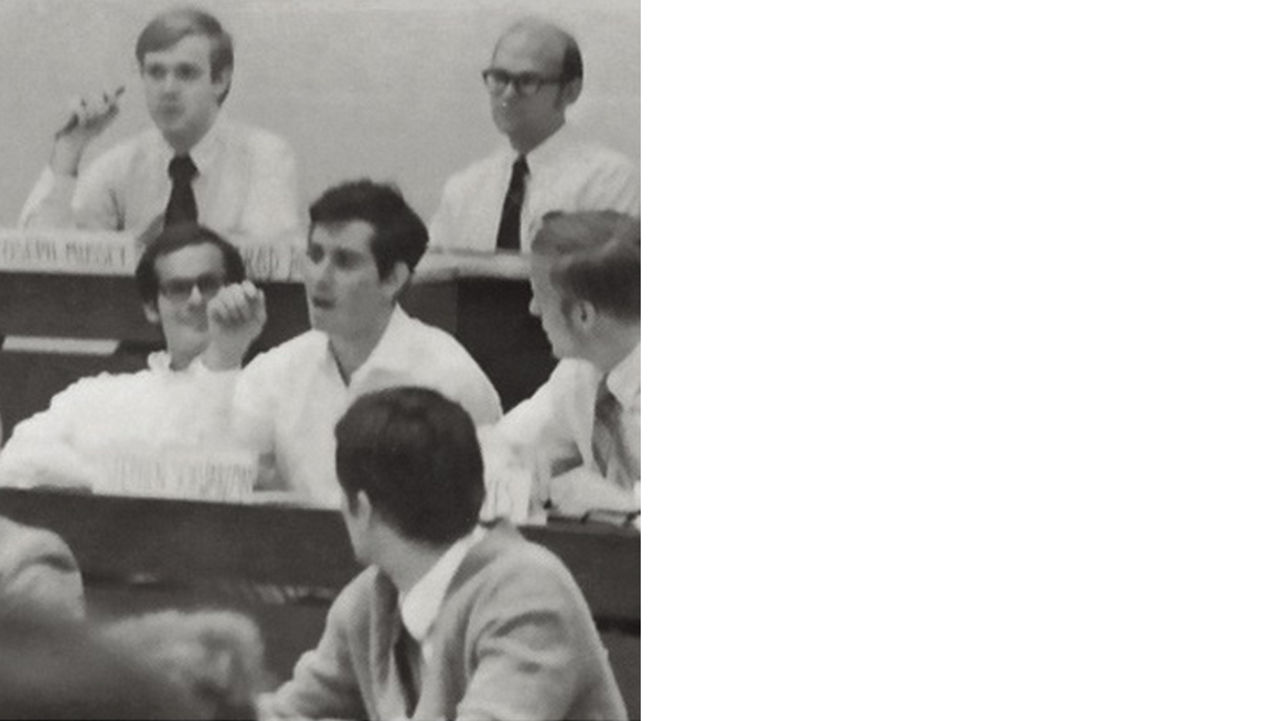
I read that long letter over and over. I still wanted to leave, but I told myself that Dick was smarter than I was, and that he had the advantage of experience. So I stayed. In time, I became president of the Century Club, which admitted only the top students. I also started a series of talks built around hearing from men only a little older than ourselves, people just beginning their careers but already enjoying remarkable early success.
Among those I invited were John Kerry, who had fought in Vietnam and would one day become the Democratic nominee for president, and Michael Tilson Thomas, who would later conduct the London Symphony Orchestra.
Connections with people can change a life, provided you are open enough to ask them anything. Had it not been for Dick, I cannot say what would have become of me. The age of letters may be gone, but to this day I read every email that comes to me.
I also set my mind to reforming what I saw as a stagnant HBS. To me, the problems were everywhere: students who were not learning enough, faculty who were not teaching well enough, an outdated curriculum and a cumbersome, inefficient administration. I worked up a slate of proposals and carried them to the dean, Lawrence E. Fouraker, Larry Fouraker.
He had no appetite for it. It took months just to arrange a meeting. When I finally sat down with him and laid out my reforms, he brushed them aside. "Mr. Schwarzman," he said, "have you always been a misfit?"
I answered him directly. "I'm used to talking to people in authority," I said. "And when you see something that can help their organization, they usually welcome that."
"Well, young man," he said, "I appreciate your coming in. But I don't think we should continue this conversation any further."
At last I understood why HBS felt so lifeless to me. The problem began at the top. An organization, I learned then, is only ever as good as the person who leads it.
Originally published in the Nikkei, October 2026