

A race run together broadened my vision and taught me life lessons.
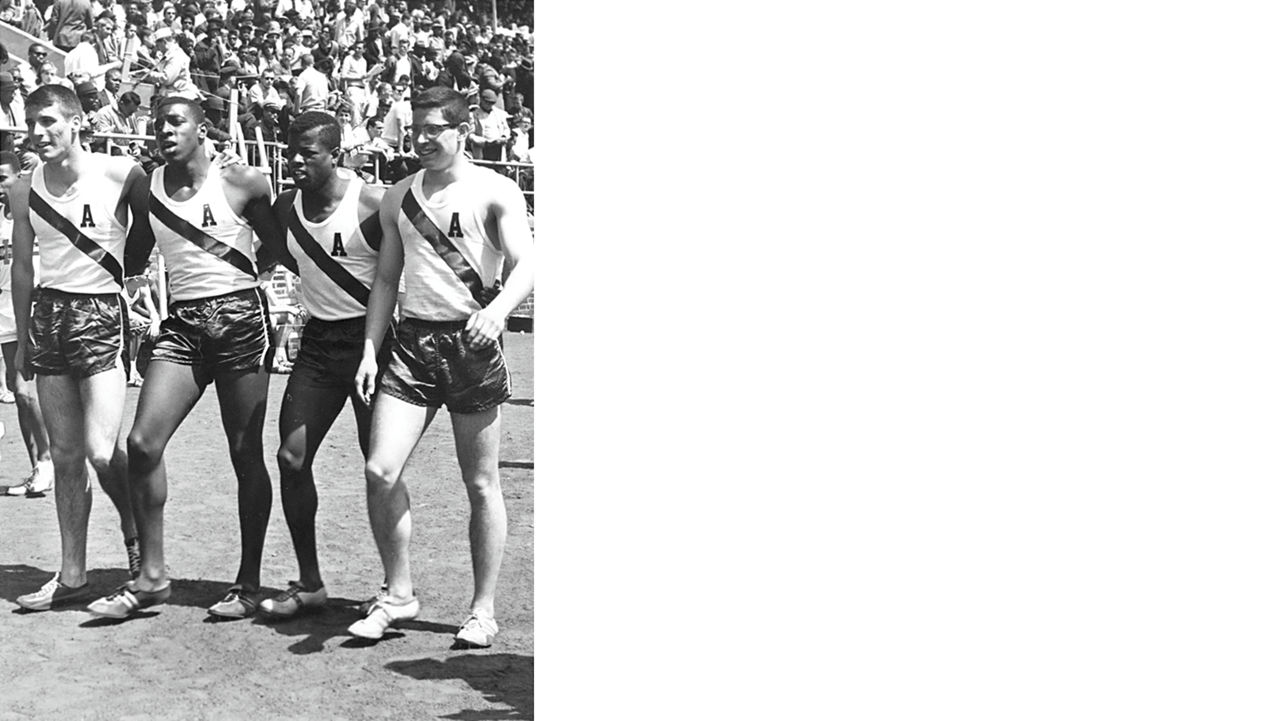
The Abington Senior High School track team was a powerhouse, and in the relays I never lost. I ran the first leg. my teammate Bobby Bryant, an African American sprinter and the fastest runner on the team, ran anchor and brought us home.
In many ways, Bobby and I were complete opposites. I was a grinder by nature. Training so hard that I was often sick by the end of practice. Bobby hated practice yet he was a natural athlete, a prodigy who became Pennsylvania state champion in the sprints.
Our academic lives were just as different. I was an honor student and student body president. Bobby struggled academically.
But Bobby had gifts no classroom could measure. He was openhearted, funny and instantly lovable— always cracking jokes and making everyone around him laugh. We took to each other immediately and were soon inseparable.
Once, our relay winning streak nearly came to an end. It happened at an indoor meet in New York. We were running a combined 880 yards, roughly 800 meters. Halfway through the turn, I felt a muscle tear in my right leg.
I fell far behind and handed off the baton in last place. Then I sat down and hung my head, ashamed and in pain.
After a while, I noticed the crowd growing louder. Our second and third runners were closing the gap.
Even so, when Bobby took the baton, he was still 12 yards behind the leader. In a race like that, 12 yards is a mile. You are not supposed to be able to make it up.
Bobby did make it up. With an astonishing burst of speed, he ran down the field and won. When the race was over, he walked over to me, put his arm around my shoulder, and said, "Steve, I did it for you."
Bobby and I truly loved each other, and there was almost nothing we would not have done for one another. Our partnership had been so successful, and our run together so intense, that it felt a little like having gone through combat side by side and survived.
I owe Bobby a lifelong debt. He opened a door for me into the African American community and became one of the catalysts for my growth as a human being.
Track and field brought me into a world I might otherwise never have known. Weekend after weekend I spent time with Bobby, his friends and their families. Before long, I had more African American friends than white ones. When I was elected student body president, I was proud to have the support of such a wide range of students.
Across America, inequality was everywhere, sometimes visible, sometimes hidden in plain sight. Through Bobby and my other friends, I came to understand in my bones that African American Americans faced obstacles that white Americans did not.
In those days, very few African American students went on to elite universities unless they were exceptional athletes. To break through, people needed not only talent but help, encouragement and someone willing to open a door. That was the reality I witnessed firsthand while still in high school.
Bobby later served in the Vietnam War as a sniper.
"They'd drop me in the dark by helicopter," he told me matter-of-factly after he came home. "Then I'd climb up a tree and wait for it to get light, and then I'd pop people."
Some police departments later wanted to hire him as a sniper. He did not take the offers. I urged him to consider it. I told him it would give him a livelihood and some security as he grew older. I even argued that in that role he would be shooting only bad guys.
Bobby would not do it. "I'm not a killer," he said.
So I tried to help in other ways. I brought him job offers. When they did not work out, I brought him others. I helped him financially to buy the house with the pool his wife wanted. When he founded a community football league, I also helped fund it.
Bobby died in 2015, at the age of 68. An Abington High reunion was being planned, but I could not find his name on the list of attendees. I called him and left a message.
He called me back. He said he could not make it because he was not feeling well.
"Geez, I'm sorry about that," I said. We talked for a while about this and that.
Two days later, his son called to tell me Bobby had died. When I mentioned our phone call, his son was astonished.
"I don't know how that was possible," he said. Bobby had terminal cancer, he told me, and had been in a coma for several weeks.
But I know what happened. Bobby had summoned the last of his strength to say goodbye.
I was the only white person at his funeral. I gave a eulogy. It was a beautiful sendoff.
Every person is born with a destiny of his own. In judging others, we should not measure them by what they lack, or by what we wish they were. We should honor them for the qualities they do possess, and for the light they bring into the lives of others. I learned that from Bobby when I was still a teenager.
Originally published in Nikkei Asia, October 2026