

Building a war chest before the storm.
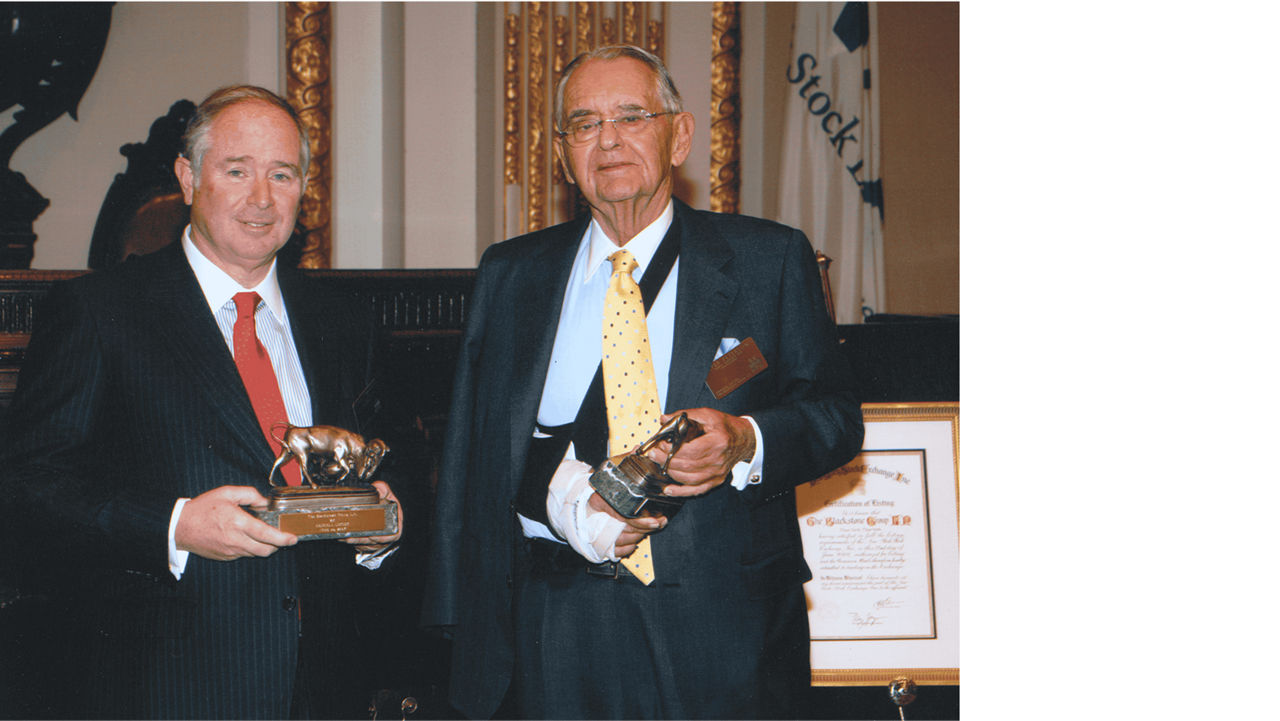
In 2007, Blackstone decided to hold an initial public offering, the first firm of its size in the industry, anywhere in the world, to do so. It would prove more than a turning point in the way we ran the company. It became a mirror of the shifting geopolitics of the era.
The idea for the IPO was not mine. It came from Michael Klein, an investment banker I had known for years who was then head of Citigroup's corporate and investment banking division. He called me on a Saturday morning in May 2006. I was still in my pajamas, halfway through breakfast, when the phone rang.
"You need to talk to me right away about something," he said, insisting that he come over and speak to me in person. "I can be there in 20, maybe 25 minutes."
"Well, Michael, this must be really important," I said.
"Yes," he replied.
Over breakfast, he came to the point.
"Steve, I think you should go public," he said.
"Why is that?" I asked, taken aback.
I had never once considered it.
Michael pressed his case. The chief advantage, he argued, was gaining access to perpetual capital. Our investors committed money to funds with fixed terms, and eventually we had to return it. Capital raised from the public markets carried no such obligation. It would be ours to keep.
There was also the question of compensation. Having publicly traded equity would allow us to reward our teams with stock in the firm, rather than bonuses tied to their own corners of the business. That, Michael argued, would reinforce the "one firm" culture that we had worked so hard to build. And Pete, Peter G. Peterson, our co-founder and chairman, was approaching retirement. Raising equity would also help us fund his later years.
I voiced a number of concerns, but the one that weighed on me most was control. Pete and I had built the firm by keeping the voting power between the two of us. That allowed us to think in terms of decades rather than quarters.
Even so, I thanked Michael for the idea. As I mentioned in the previous installment, we could already hear the first rumblings of the financial crisis approaching, and shoring up our capital base had real appeal. On one point, however, I pushed back. Michael had penciled in a projected market valuation of $30 billion.
"No," I told him. "Thirty-five."
The following Monday, I brought the idea to Tony James, our president, and we began preparing for a listing the next year.
We decided that the public could buy into Blackstone's economics, but not its governance.
Calls also came from Congress and organized labor for Blackstone to put its listing plans on hold. Buyout firms in general were taking intense, often unfair, criticism at the time. . In many ways, our IPO became a mirror of America's economic and social mood at the time.
We went public in June 2007. Demand for the new units was overwhelming and the offering drew more attention than any IPO since Google's in 2004. In the run-up to the listing, three foreign governments approached us, each seeking to establish a relationship by taking a stake in the company. I chose China without hesitation.
China's growth at the time was extraordinary. Since joining the World Trade Organization in 2001, the country had been accumulating capital from around the world through its exports. That made it a natural source of investment for us. It was the same logic, in essence, that had led us to Japan in the late 1980s.
For China, it was the country's first major outbound investment since the end of World War II. U.S.-China relations were good in those days. I suspect Beijing wanted to show Washington that it was recycling its export earnings in a way that helped stabilize the global financial system.
During a trip to Beijing connected with the deal in 2007, our partner in China, Antony Leung, told me there was someone in Shanghai I ought to meet. I was tired and tried to beg off, but he insisted, saying, "Steve, you really need to do this."
So I flew to Shanghai, where I was introduced to the city's top official. His name was Xi Jinping. Today he is China's president.
Blackstone's IPO became the starting point for my deepening ties with China. It set in motion much of what followed: my later efforts to ease tensions between Washington and Beijing by helping convey President Trump’s agenda, and my founding of Schwarzman Scholars, a one-year, fully funded master's program in global affairs at Tsinghua University in Beijing that aims to help young people from abroad gain a deeper understanding of China.
All of it traces back to that moment.
Originally published in the Nikkei, October 2026