

For Japan to keep drawing capital, it has no alternative but to continue reforms.
It was 2013, I believe. At the Four Seasons, a restaurant near our New York headquarters, I had lunch with an acquaintance visiting from Japan.
"Japan is changing," he told me.
I was skeptical. People had been saying that for 25 years, I thought, and nothing had really changed.
Blackstone had withdrawn from Japan in 1998, after the collapse of the nation's asset-price bubble had left the economy mired in a long period of deflation and stagnation.
"No," he insisted. "The new prime minister, Shinzo Abe, is moving on any number of fronts. His way of thinking is entirely different from anything Japan has seen before. New thinking. Trust me, this time, it really is change."
The following week, at our regular Monday meeting, I mentioned that conversation and we began analyzing the situation in Japan. We concluded that Japan was coming back into the real world. The Abe government was trying to reshape corporate behavior by strengthening shareholder rights, and to sharpen the nation's competitiveness through deregulation.
Was this really happening? In Japan, of all places? Part of me remained unconvinced. But the answer, increasingly, was yes.
Even the faces of the people arriving from Japan seemed changed. Those who had once been despondent about the country's prospects now seemed almost electrified by the possibility of renewal. It was the Japanese themselves who had decided that their country had to change—and who sensed that it finally had.
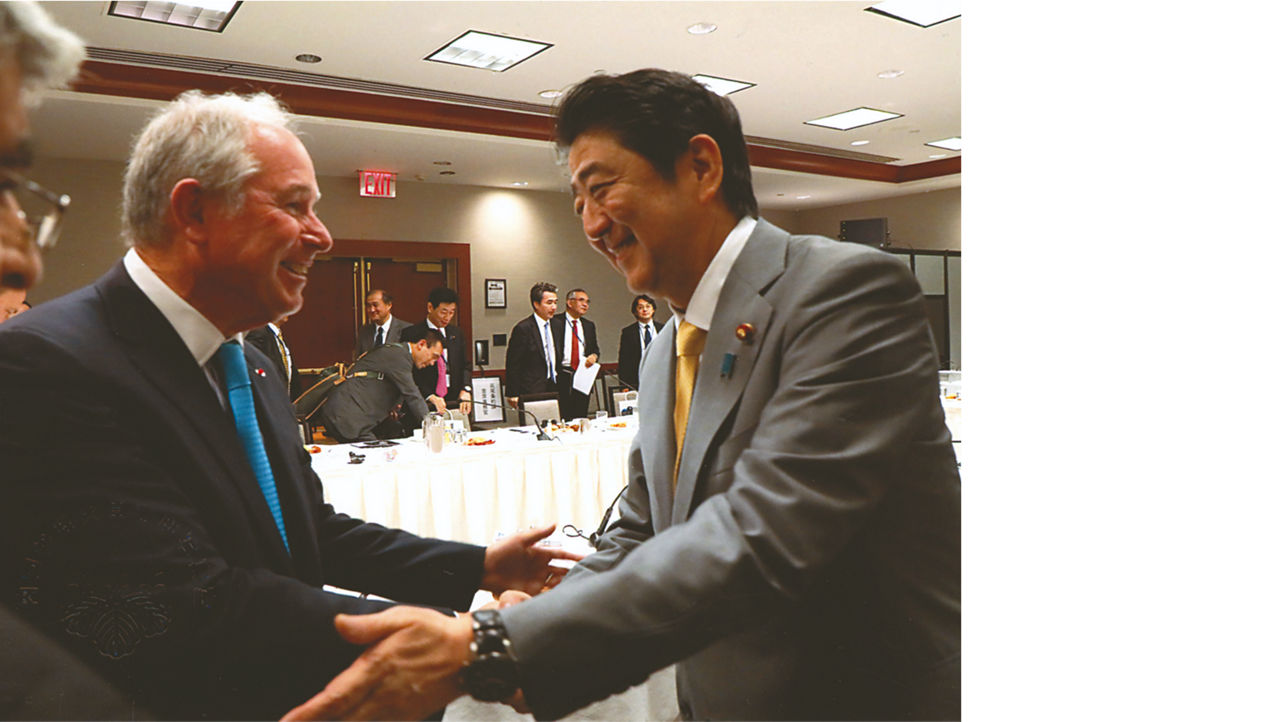
I first met Abe in September 2017 at a breakfast he hosted while visiting New York. He had invited a group of leading figures from American business. He spoke with evident pride about the results of Abenomics, his program for pulling Japan out of its long deflationary torpor and restoring confidence in the economy.
I mentioned that I was also watching the economic effects of the upcoming 2020 Tokyo Olympics. When I complained that I would like to visit Japan for the games but could not get a hotel room, Abe shot back, "Well, in that case, why don't you start your own hotel business in Japan?" The room erupted.
From that point on, we made a habit of meeting whenever the chance arose. He was extraordinarily alert and intelligent, and, unlike many Japanese politicians and executives I had known, he spoke with striking directness.
As a result of Abe's reforms, our conversations with Japanese companies became almost unrecognizable compared with a decade earlier. It felt like a revolution.
Japanese companies began doing business with foreign firms such as ours as a matter of course. They no longer automatically resisted the idea of unloading investments in businesses with little future. These were the kinds of conversations which, in the old Japan, would have been almost unthinkable.
The most dramatic change remains concentrated, for now, among Japan's flagship corporations. But the base is broadening. Blackstone has returned to Japan and our business there is expanding in real estate, in corporate investments, in investment products for individuals and in other areas.
In 2021, the Appeal of Conscience Foundation, an American organization with which I am involved, presented Abe with its World Statesman Award. He deserved it. He was a political leader of global stature and one with the courage to pursue social change and bold new policies.
And so, the following year, when Abe was shot dead, I sank into a deep gloom. I felt it not merely as a Japanese tragedy, but as a loss to the world.
In the United States, President John F. Kennedy and his younger brother, Sen. Robert F. Kennedy, were both assassinated. Presidents Ronald Reagan and Donald Trump were both shot. But Japan was a country where such political violence seemed almost unimaginable. Why there? Why Abe?
Abe was a symbol of innovation. A person who sets out in earnest to change things sometimes attracts the unhinged—those who fear change, resent power, or cannot abide the force of a leader's conviction. It was a profoundly sad way for a life to end.
Since 2013, when Abe set about changing the country, the Japanese economy has been moving on a far better path. When a nation acquires a more forward-looking collective psychology, its momentum can last five years, even 10.
When the renowned American investor Warren Buffett caused a stir by declaring that he would not sell his shares in Japanese trading houses for 50 years, that was his characteristically plainspoken way of saying that Japan's economic momentum was real—and I agree with him.
Yet experience has taught me that momentum is never permanent. Nothing is.
When a government's thinking changes sharply, one has good reason to reexamine and rethink one's investments, especially when policy turns hostile.
For Japan to keep drawing in capital, it has no real alternative but to continue the reforms Abe began, to channel the vast sums of cash lying dormant in households and corporations toward productive ends, and to keep the country moving forward.