

One certainty: AI will play an ever larger role in our business.
Imagine Blackstone 20 years from now.
One thing, I believe, is beyond doubt: Artificial intelligence will occupy an even larger place in our business than it does today.
As I said at the beginning of this memoir, we are already the world's largest owner of data centers—the infrastructure without which modern AI cannot function.
Demand for everything those facilities require will continue to grow: electric power, semiconductors, cooling systems and networks. Each represents an enormous investment opportunity with the potential to generate exceptional returns.
We have also turned our attention to the household names driving the AI revolution itself. Before its much-discussed initial public offering this June, we invested in SpaceX. This year we also partnered with Anthropic and Google to help bring AI into businesses around the world.
"
Today, every investment committee we look at, the first few pages have to highlight the AI risk to the business.
When I think about AI, three conversations stand out in my mind.
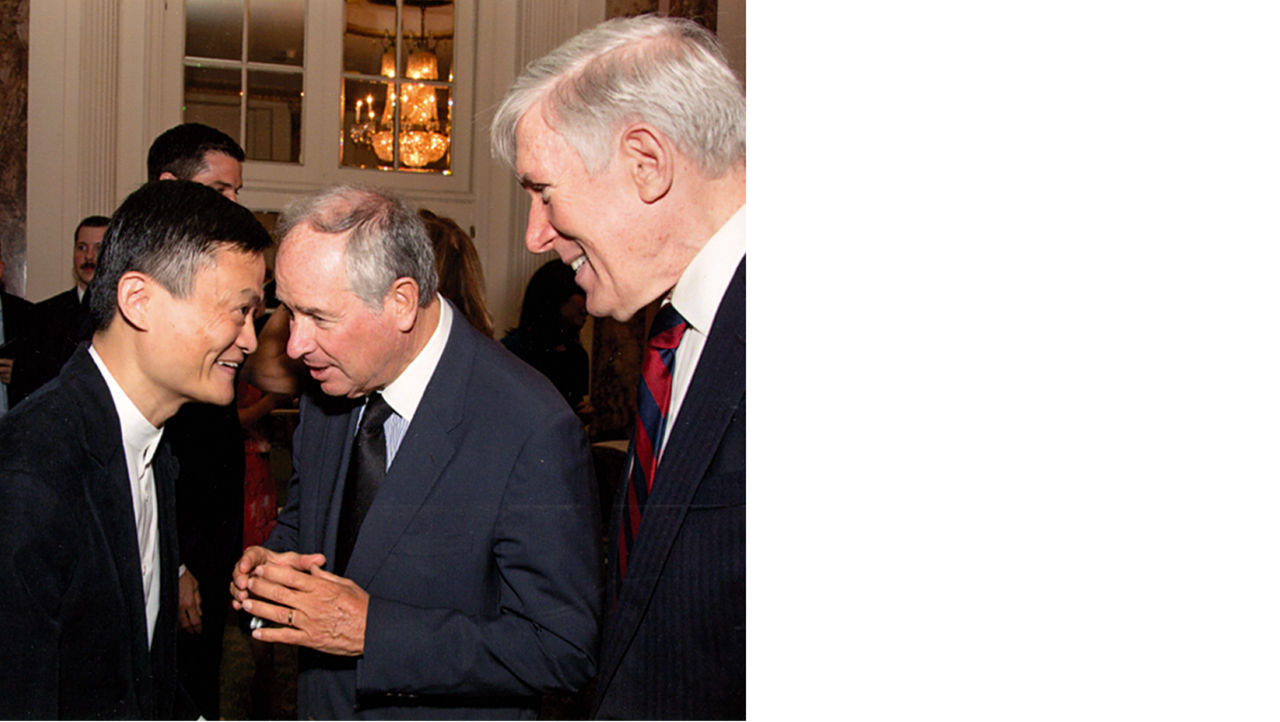
The first was with Jack Ma, the founder of Alibaba, China's online marketplace giant.
In 2015, we happened to be seated next to each other on a bus during a visit to China. For much of the ride, he spoke enthusiastically about artificial intelligence.
"This is the most powerful technology of our generation," he said. "It will do extraordinary things and improve the lives of people everywhere."
I simply stared at him. At the time, I had little idea what he was talking about. But he planted a seed of curiosity.
The second conversation came with Rafael Reif, then president of the Massachusetts Institute of Technology.
He explained that AI had, in a sense, been born in the United States in 1956. The ideas had existed for decades, but computers simply lacked the processing power to make them practical.
That obstacle, he said, had finally disappeared. "Now it has that power, and you're going to see these phenomenal types of breakthroughs."
The third conversation came shortly after ChatGPT burst onto the scene in 2022.
Satya Nadella, Microsoft's chief executive, hurried to see me wearing a black T-shirt. He spoke with unusual urgency.
"We never imagined anything like this," he told me. "We've already reached one hundred million users. I need everything."
By "everything," he meant infrastructure. I told him we already owned a data center company. "Really?" he replied. "Then we should talk."
That conversation opened the door to a much larger role for Blackstone at the forefront of the AI revolution.
Twenty years from now, Blackstone will be larger still.
Alternative investments have only begun to reach individual investors, and we will continue creating products for them. We will also become increasingly global, offering more investment vehicles denominated in currencies other than the U.S. dollar.
One thing, however, will never change.
We will not enter businesses that cannot be profitable.
I want businesses whose connection to market demand is so powerful that they become profitable within their first year.
Many firms spend years nurturing ventures that consume cash before producing a return. That has never been our philosophy. I hate losing money.
Our test for launching a new business is remarkably simple. Can the idea attract capital? Can it attract exceptional people? If the answer to both questions is yes, profitability usually follows.
Great ideas draw investment, and they attract extraordinary talent. Once you have both, you have already solved most of the problem.
The secret is not to expect ordinary people to perform extraordinary feats. It is to find extraordinary people and let them do what comes naturally to them.
Jon is still only 56 years old. I expect Jon to be leading the company for at least the next 15 years, including after he succeeds me as CEO.
I have served in that role for more than four decades. Together, that amounts to nearly 60 years of remarkably consistent leadership.
Inside the firm, Jon thinks very much as I do. In many respects, he is probably better than I am. That kind of continuity is extraordinarily rare in finance. Berkshire Hathaway under Warren Buffett is one of the few comparable examples.
In the end, building a great financial institution comes down to two abilities. The first is avoiding losses. The second is recognizing the next great opportunity before others do.
Those two principles have guided Blackstone from the beginning. Jon understands them completely. I have every confidence that he will carry them forward.
Twenty years from now, someone else may already have succeeded him. I am not worried.