

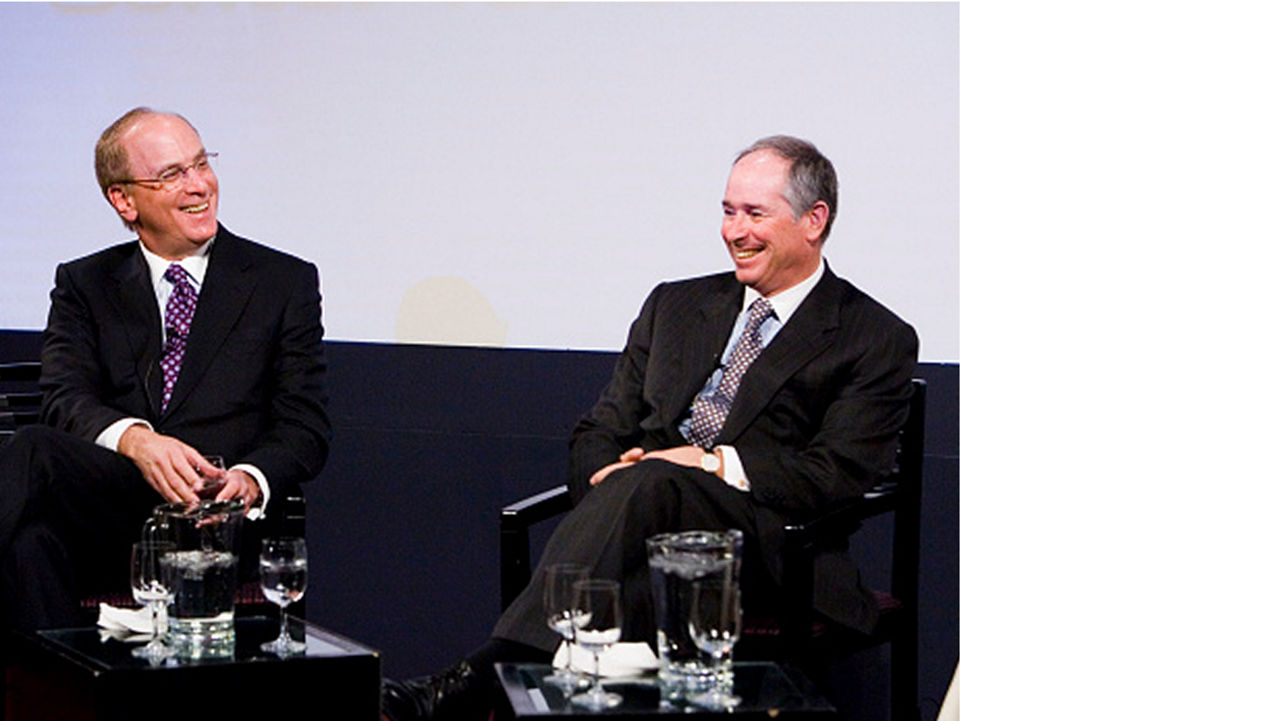
Parting ways with the future BlackRock founder was a costly mistake.
There is, as almost everyone in finance knows, another asset-management firm whose name bears a striking resemblance to ours. It is BlackRock, the largest asset manager not only in the United States but in the world.
Its chairman and chief executive is Larry Fink. What is less widely remembered is that BlackRock traces its origins to a business Larry once ran under the Blackstone umbrella.
Larry had been a star banker at First Boston, where he made a fortune trading mortgage-backed securities, bonds backed by pools of home loans.
He was one of the Wall Street pioneers who helped turn mortgage-backed securities into a vast asset class, one that, in its agency form, would become the world's second-largest bond market after U.S. Treasuries.
I have already described Larry as one of those rare talents who score an 11 out of 10. He was exceptionally smart, creative, innovative, and a natural leader.
So in 1988, when he confided that he was leaving First Boston after taking responsibility for trading losses there, Pete Peterson and I welcomed him gladly.
We established Blackstone Financial Management, half owned by Blackstone and half by Larry and his team, and made Larry a partner in the firm.
I learned a great deal from him. He opened our eyes to the intricacies of mortgage securities and the housing market, areas that had been far beyond our grasp. Larry's team also raised capital from individuals, whereas Blackstone in those days relied largely on pension funds and other institutional investors. He showed me the power of selling investment products directly to individuals, an insight whose implications reach all the way to the present.
Larry and his team were brilliant. I was convinced they would become the biggest in the world at managing mortgage-backed securities. And that is precisely what they became.
Regrettably, in 1994, they left Blackstone. The agreement was clear: Blackstone and Larry's team would each reduce their stakes to 40 percent, with the remaining 20 percent reserved for employees. Any further dilution would come from Larry's side.
When they later asked Blackstone to give up more as well, I refused. I stood on the deal, and the partnership unraveled.
It was a colossal mistake. Had Larry's team stayed, Blackstone today would combine its enormous alternatives business with an equally formidable liquid-investments arm. Our market capitalization would almost certainly be vastly larger.
The problem could have been solved simply by amending the contract. The lesson I drew from that error was this: Circumstances change, and one must remain flexible enough to change with them. I should have recognized that when a business is doing extraordinarily well, rigid adherence to an old agreement can become its own form of shortsightedness. Sometimes, to preserve a great opportunity, you have to make accommodations.
That it was not a bitter divorce should be evident from the fact that Larry's firm still shares our family name. When they were choosing a new name, "Black Pebble" was one of the candidates. Larry consulted me, and I told him that bigger was better. I pushed for "Rock."
The world is a small place, and Larry and I still cross paths frequently at conferences and meetings. This past May, when President Donald Trump traveled to China to meet President Xi Jinping, we both accompanied him.
At the end of 2024, Larry even made a guest appearance in Blackstone's celebrated holiday video. Watching our executives clowning around from a BlackRock building in the distance, he deadpanned, with a look of mock exasperation, "And you believe people confuse us with them?"
Would we ever join forces again? There is no possibility of it, and we have never even considered the idea. The cultures of the two firms have simply grown too far apart.
Larry built his empire through acquisition after acquisition, expanding beyond mortgage securities into index investing and many other fields, and issuing new shares to pay for those deals. I am proud of BlackRock and of Larry's success.
Blackstone, however, has followed a different path. We have generally disliked M&A, because we are determined to preserve our culture. We have built most of our new businesses internally, even when doing so took more time. Nor do we like issuing new equity, since it dilutes earnings per share.
And yet the mere fact that our names are joined by history creates a psychological bond between us. In family terms, Blackstone and BlackRock are cousins.
Originally published in the Nikkei, October 2026