

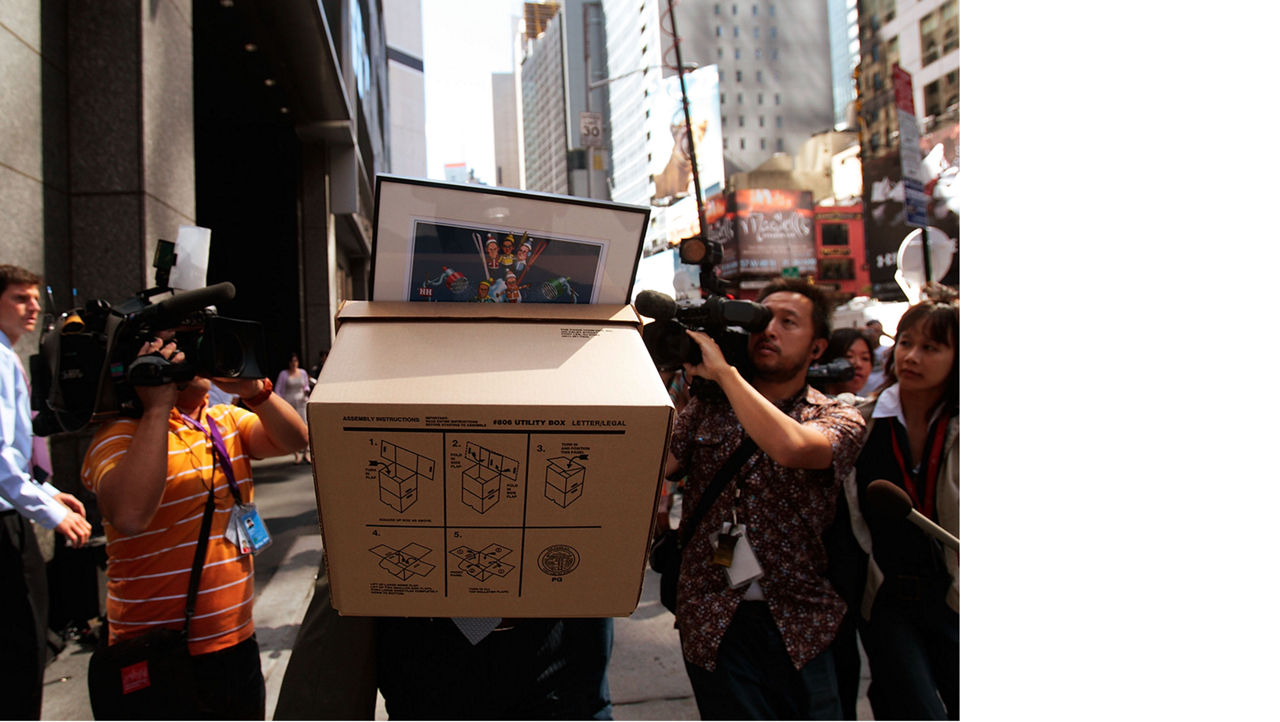
Pushing for a short-selling ban on bank stocks to stem the panic.
I have already described how, around 2006, I first heard the approaching footsteps of the financial crisis.
But the thread that would lead me there had come into my hands earlier still.
In 2002, after the accounting frauds at Enron and WorldCom came to light, the Sarbanes-Oxley Act was enacted.
The law sought to make corporate accounting more transparent by holding executives responsible when there were problems with the accuracy of financial reporting. In the same climate of demands for "transparency," the move toward fair-value accounting gained momentum.
Financial institutions were heavily indebted, investing in securities with funds amounting to as much as 30 times their own capital.
Markets, by their nature, are constantly in motion. Yet under a regime that demanded strict accounting transparency, when market values fell, firms were required to record large write-downs, even though the losses had not been realized through actual sales. Once the market became aware of those losses, panic set in.
It was in 2006, I believe, that I had dinner with Senator Paul Sarbanes, one of the two principal sponsors of the corporate-accounting reform law, and pressed him to revisit it.
I told him that the law was going to lead to "the collapse of the global financial system."
His reply was that of a man already halfway out the door. "I'm retiring in one year. I don't care. And if you're right, somebody else will fix it."
I insisted that I wanted him to fix it, but the conversation went nowhere. "We thought we were doing the right thing. I still think we're doing the right thing," he said, repeating that he would soon retire.
I also encouraged a young reporter at The New York Times to sound the alarm. "The global financial system's gonna collapse because of mark-to-market accounting," I told him. He was willing enough to write the piece, but it was spiked. According to the journalist, The New York Times decided it was "so crazy and irresponsible."
The global financial crisis began in 2007, when the U.S. subprime mortgage crisis spread into the broader financial system.
The authorities were not blind to the danger. Treasury Secretary Hank Paulson, Federal Reserve Chairman Ben Bernanke and Tim Geithner, president of the New York Fed, gathered the heads of finance in New York every month to develop a real-time understanding of what was happening.
The group included me and the chief executives of Wall Street, among them Dick Fuld, who ran Lehman Brothers. Discussions grew awkward whenever Lehman came up – I was watching Lehman's influence drain away before my eyes.
Dick and I went back a long way. We had been promoted to partner at Lehman in 1979. In March 2008, JPMorgan Chase agreed to take over the stricken Bear Stearns in a government-brokered rescue.
Now all eyes were on Lehman. Was it next? Its share price kept falling.
I proposed restructuring plans to Dick several times, the last of them in August. The source of Lehman's trouble was its real estate investments. My idea was to carve out that business, put the impaired assets aside and wait for the market to recover. To give the plan credibility, Blackstone was prepared to invest as well.
Dick seemed receptive. But three days later he called to say no. The necessary legal procedures would take three months. In the meantime, Lehman would have to announce its results for the June-August quarter, and there would be no way to avoid taking "significant write-downs" on its real estate assets.
In September, my old firm met its tragic end. Had I made the proposal three months earlier, Lehman might never have collapsed. The regret was bitter.
What I urged on Hank was a clampdown on the short selling of financial stocks. Hedge funds, anticipating further declines, were shorting the banks. Depositors, frightened by the falling shares, pulled their money out, and the falls accelerated.
"Listen, why don't we just change the rules and make it impossible for people to short financial institutions?" I said. That way, I argued, short sellers would realize that in a developing crisis the rules could change, leaving them trapped in positions that could move against them. Instead of falling, the securities could rise, inflicting huge losses on those who had bet against them. The rules were changed.
Within Blackstone itself, there was only one thing to be done. I kept telling our people, again and again, that our finances were in exceptionally sound condition.
The stock offering of the previous year had been the right decision. We had raised an enormous sum of capital in conjunction with the listing, and there was no danger of our being squeezed for funds.
Our share price had plunged, as had those of every other financial institution, but this was no problem particular to Blackstone. To our employees around the world, I preached the same message over and over: Do not indulge in a "wrong worry."
Originally published in the Nikkei, October 2026