

How a commercial paper business spiraled out of control and killed Lehman.
Lehman Brothers was riven by internal strife. The conflict was not confined to rival divisions. It ran through them as well, driven by power, resentment and personal ambition.
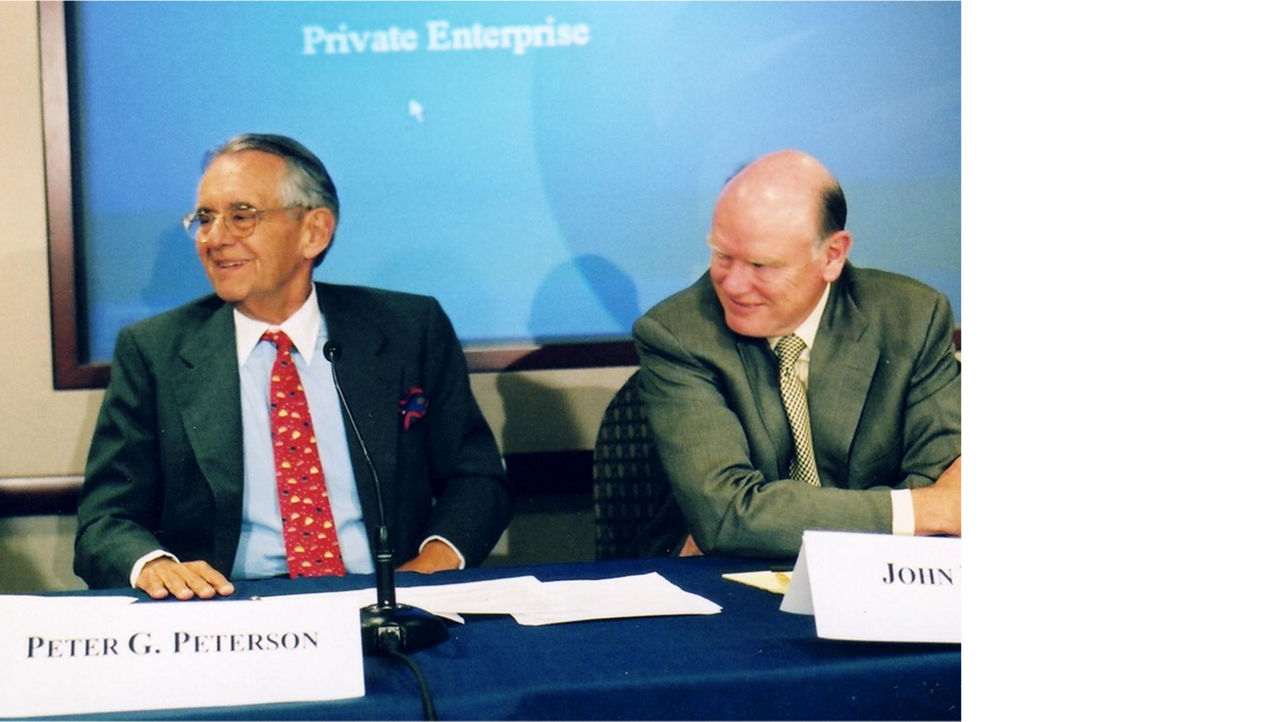
In 1973, the firm brought in Pete Peterson as CEO. Pete had served as U.S. secretary of commerce and would later found Blackstone with me. At Lehman, he was a compromise candidate. The partners thought that because he knew little about finance, he would be easy to control.
Even Pete, however, would eventually be driven from the chief executive's chair. In 1983, Lew Glucksman, who headed the trading division, forced him out. I later asked Pete why he had not fought harder when Lew pressured him to leave. Pete simply walked away. He did not want, he said, to "destroy the firm over my own position."
The irony was that the firm fell apart a year later all the same.
After pushing Pete out, Lew began to court me. He demanded meetings with me that began at 6:30 in the morning and ran for two and a half hours.
Ever since Pete had arrived at Lehman, I had been something of a confidant to him. Perhaps he was sounding me out, trying to draw me into his camp. I was in investment banking, serving corporate clients, and had little professional contact with Lew, whose power base was trading.
The meetings ended after three or four sessions. At the last of them, Lew looked at me and said, "You know, you're very smart and capable, but I'm not gonna give you my job."
"Excuse me?" I said.
"I know you're after my job," Lew replied.
I denied it, but he would not let go.
"Why would you think I'm after your job?" I asked.
"Because I know you are."
Lew was a formidable figure. He had made a fortune in trading and had risen to the top of Lehman through force of will. That made it all the more surprising that he should regard me as a threat.
In one sense, his grim premonition proved correct, though not in the way he imagined. Against my own intentions, I would soon play a part in the process by which he lost control of the firm.
By 1984, Lew's brief reign had left Lehman divided and badly short of capital. In mergers and acquisitions, I helped arrange the sale of the firm to Shearson/American Express. The deal ended Lehman's independence, and the new owner removed Lew.
The immediate crisis lay in Lehman's commercial paper business. The firm had built a major operation dealing in short-term, unsecured debt issued by companies, usually with maturities of 30 to 90 days.
Lew and his team had grown greedy in a rising market. In violation of Lehman's internal rules, they had moved beyond short-term commercial paper and bought notes with maturities of as long as five years, exposing the firm to far greater interest-rate risk. When the market turned against them, the unrealized losses mounted until they threatened Lehman's capital base.
It was on a Thursday that the partners discovered the scale of the losses and resolved to sell the firm. I believed that unless we found a buyer and closed a deal by Sunday, word of the losses would leak, Lehman would lose the market's confidence and everything would come crashing down.
The deal was closed in time. But it was not a happy outcome. Lehman could no longer survive as an independent house, and that left me hollow.
There had been another possible path. We might have brought in outside capital to shore up the balance sheet. But the partners were divided, and reaching agreement over a single weekend on who would lead those negotiations was impossible. In the end, the only choice left was to sell the firm outright. It was the simplest way to preserve what value remained.
Some of the senior partners failed to do the right thing. They should have stood up to Lew, who had broken the rules and tried to conceal the losses. They did not. They were afraid of him. He held the power of life and death over their careers and they knew it.
It was at Lehman that I came to understand the danger of internecine conflict. When people begin acting for themselves rather than for the institution, cooperation breaks down. Trust disappears. Decisions become distorted by ambition and fear. In time, the dysfunction weakens the business and can destroy it.
That lesson stayed with me.
From the day Pete and I founded Blackstone in 1985, I told our people there were two ways to get themselves fired. One was to fall short of the performance we expected of them. The other was to get involved in internal feuds.
We also built a mechanism to prevent such feuds from overwhelming the firm. At the founding, Pete and I held 100% of the voting rights between us, so we could always make decisions in the best interests of the organization.
Originally published in the Nikkei, October 2026