

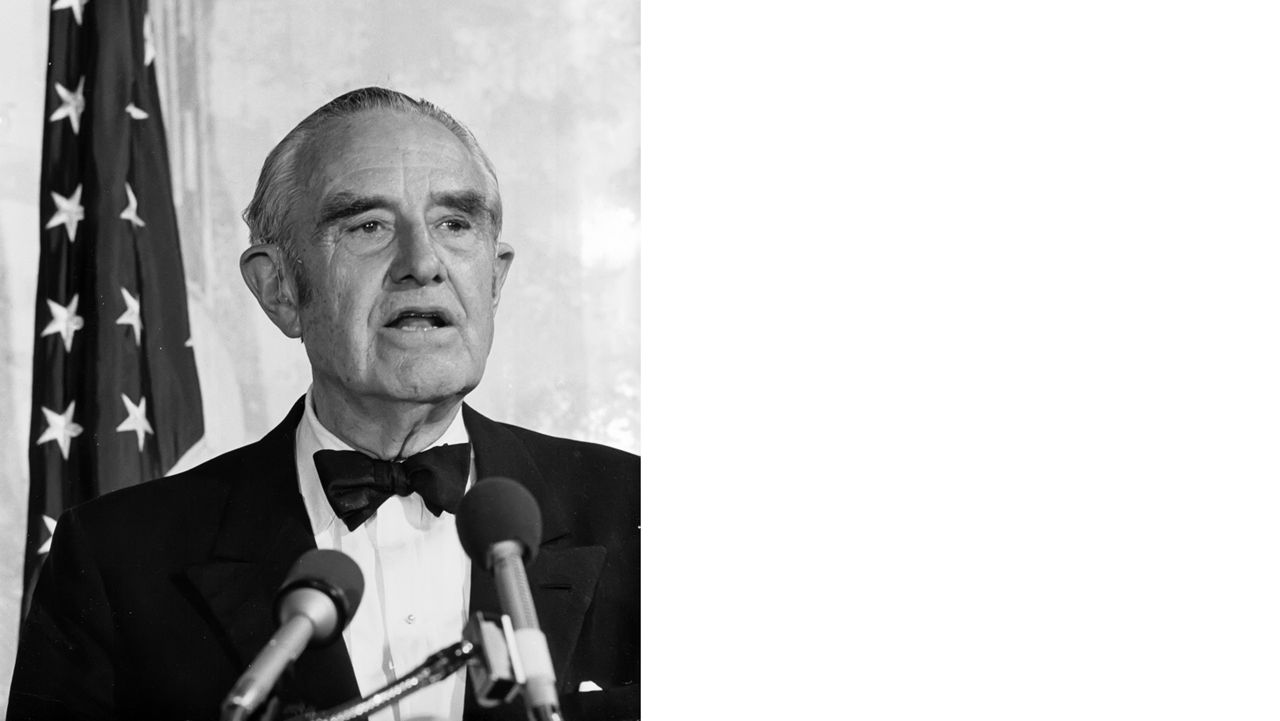
The son of "the Railroad King" taught me the value of financial independence.
Before graduating from Yale in 1969, I wrote to Averell Harriman, one of the most distinguished alumni of Skull and Bones, asking if I might come to see him for advice about my future.
To me, Harriman embodied the very idea of a statesman. Approaching 80, he had already lived several public lives, moving with authority through the worlds of business, diplomacy and politics.
His father, Edward Henry Harriman, was himself a figure of legend: a railroad magnate of immense fortune who had built his power through control of such great rail networks as the Union Pacific and the Southern Pacific, earning the sobriquet "the Railroad King."
The Harriman name had even touched Japan: After the Russo-Japanese War, E. H. Harriman briefly explored a joint railway venture in Manchuria with Prime Minister Taro Katsura, though the plan came to nothing.
For my meeting with Harriman, I bought my first suit. When I rang the bell at his Manhattan town house, a butler in a white jacket and bow tie, the like of which I had never seen, opened the door with grave deference. I was shown into Harriman's sitting room and seated close beside him, for his hearing had grown poor. "Well, young man," he said, "What brings you here today?"
Over the next two and a half hours, lunch included, the story of his life unfolded before me as one astonishment after another.
The Bolsheviks, having seized power in the Russian Revolution of 1917, were eager for American capital and foreign currency. Great American fortunes—the Harrimans, the Mellons and others—were drawn to the possibilities of doing business with the new regime. As Harriman told it, he went to Russia as a young representative of those interests and found himself dealing directly with the Bolsheviks and their world. Among those he met was Leon Trotsky.
He came away with a conclusion of grave importance. The Soviets, he believed, had induced the Americans to help build factories and other industrial assets but had no intention of allowing foreign investors to retain control of them indefinitely. He reported back that they should sell what they owned in Soviet Russia and get out at once.
The warning was dismissed. To the older men, Harriman was still a young man with too little experience to be taken seriously. They did nothing and, as he told the story, they lost everything when the assets were ultimately taken from them.
When World War II broke out in 1939, Harriman entered a still larger arena. At the request of President Franklin D. Roosevelt, with whom he had long been associated, he became one of the central American figures in the Allied relationship with the Soviet Union. In 1943, with the Soviet Union still under German assault, he was appointed U.S. ambassador to Moscow.
Moving among the leaders of the Allied powers—Roosevelt, Joseph Stalin, and Britain's Prime Minister Winston Churchill—he helped coordinate the flow of war material and other aid that sustained the common fight against Germany.
At the time of our meeting, Harriman was again engaged in diplomacy, leading the American delegation at the Paris talks with North Vietnam, where the United States had begun the difficult work of seeking an end to the Vietnam War.
At one point during our conversation, the telephone rang. On the line was Cyrus Vance, Harriman's deputy at the Paris peace talks and later secretary of state, calling from the negotiations. Harriman listened, weighed the point, and then answered with the calm authority of a man accustomed to power: "OK, We can give on that."
I was only 21. Am I the luckiest person in the world, I thought, to be here, in this room, at this moment, watching history being made and learning from a man who had helped make so much of it?
Nor was that the whole of what I learned. Harriman gave me a piece of advice that would remain with me for the rest of my life. When I expressed my interest in politics, he asked, "Are you independently wealthy?"
"No," I said. "I have no money whatsoever."
He then spoke about the importance of financial independence in public life. If I was interested in politics, he told me, I should first go into business and make enough money to stand on my own. Only then would I be independent. Only then would I be my own person, beholden to no one.
Had his father not been E. H. Harriman, chairman of the Union Pacific Railroad and one of the richest men in the world, he said, I would not have been sitting there talking to him.
When I left his office, the sky was clear and bright. I looked around me and thought how far this world was from the one in which I had been raised. And I loved it. I had been wholly captivated by Harriman's charm, his authority and the immense scale of the life he had lived.
I wanted to tell my parents at once. I rushed to a pay phone and poured out the whole story. "I've just had the most marvelous experience," I told them.
My childhood home in the suburbs had been only slightly better than an ordinary house, with a lawn and two family cars. We had lived as ordinary Americans did. After that meeting, I felt I had been lifted, if only for an afternoon, into an entirely different order of things. That was my "Harriman experience."
Originally published in Nikkei Asia, October 2026